Development activity
Totals from synced weekly buckets (additions = lines added per provider APIs).
- GitHub commits
- 712
- GitLab commits
- 168
- GitHub additions
- 2.1M
- GitLab additions
- 713.4k
Additions and commits by week
Projects

Avocado Legal Corpus: retrieval infrastructure
Deployed and operate Avocado Legal Corpus, a South African legal retrieval platform that turns public legal sources into searchable, cited evidence. The system discovers and registers source URLs, downloads PDFs and HTML, processes layout-aware OCR, splits gazettes, manages review queues, and schedules vector ingestion from a registry of more than 100,000 source records. It chunks files with page metadata, embeds them with BGE, upserts Qdrant collections, exposes health/search/status APIs, and serves MCP tools that return quoted legal passages with citations rather than generic AI answers.
- Software Development
- Internal tooling
- SQL
- Operations
- AI Engineering
- RAG

Vacation rental websites: Hiddingh Village & Nautica
Built two production rental-property websites, Hiddingh Village and Nautica, from a reusable Next.js and Cloudflare deployment pattern. Each site has its own brand, domain, map link, inquiry flow, Notion-managed content, and Google Drive image gallery, while sharing the same reliable publishing model. The result is a repeatable small-property website system: owners can update copy and imagery through familiar tools, and each public site remains fast, maintainable, and tailored to the property instead of becoming a fragile one-off static page.
- Software Development
- Internal tooling
- Operations

OpenClaw Personal: self-hosted multi-agent operations platform
Built and operate OpenClaw Personal, a self-hosted multi-agent operations platform that coordinates specialist assistants across research, task management, retrieval, compliance, procurement, and infrastructure workflows. The project brings together agent identities, model fallback tiers, MCP integrations, skills, plugins, deployment automation, scheduled maintenance, and knowledge-map tooling into one governed runtime. Its value is not another chatbot; it is a durable personal automation layer with clear responsibilities, auditable workflows, and reusable integration patterns.
- Software Development
- Operations
- Internal tooling
- AI Engineering
- RAG

Vis: Cape Town diving visibility forecaster
Built Vis, a Cape Peninsula diving-visibility forecasting system that combines field reports, marine conditions, coastal geometry, and review workflows into a practical forecasting pipeline. It mines WhatsApp, social, and public dive observations, routes labels through a Streamlit reviewer, enriches them with Open-Meteo and Copernicus history, and trains physics-first ML and analog models. The system produces a water-filtered H3 shore-diving grid, +6h to +72h forecasts, MVT/GeoJSON artifacts, access and MPA masks, and product contracts for a future map experience.
- Software Development
- Forecasting
- AI Engineering
- Operations
- Internal tooling

Plentify: Metabase & fleet analytics
Deployed and shaped a team-owned Metabase business-intelligence platform for Plentify fleet operations, then documented the operational databases well enough to make self-service analytics practical. The work included Follower and Precog data models, canonical joins, glossary terms, metric definitions, SQL quality checks, backup and extraction workflows, dashboard plans, communications rollups, and reliability-reporting pipelines. That documentation enabled safer natural-language SQL generation and reduced dependence on a costly bespoke analytics build: the result was a modifiable, owned, widely used BI capability that could evolve with the business.
- Operations
- Internal tooling
- Software Development
- IoT
- BI
- SQL

SIM Platform Integration: fleet connectivity intelligence
Built a multi-provider SIM operations platform for Plentify fleet connectivity work. The system integrates 1oT, SIM Control, Hologram, and Telit data; normalizes ICCID, EID, and IMEI identifiers; exports Follower database snapshots; validates cross-source SIM assignments; detects stale or unassociated SIMs; and analyzes deployment distance, network operators, and hourly connectivity. It now includes a Flask workflow API, async job tracking, downloadable outputs, Google Sheets refresh support, a Flutter web interface, and a path from CSV analysis to scheduled monitoring.
- Software Development
- Operations
- Internal tooling
- IoT
- SQL
- BI

Edgecore Interface: AP/client monitoring
Built an Edgecore ecCLOUD monitoring interface for Plentify fleet operations. The system polls managed access-point sites, records AP health and last-contact status, captures wireless client association snapshots, detects association, disassociation, and roaming events, and enriches MAC observations against fleet records. The first production workflow runs as a scheduled daily sync with review tabs for AP status, current associations, event history, poll audit, and registry data, establishing the data model for higher-frequency monitoring when needed.
- Software Development
- Operations
- Internal tooling
- IoT
- SQL

3BO Bicycle & Lastmile Telematics Tracking
Product-managed 3BO, a WhatsApp-first bicycle and last-mile asset tracking platform built around rapid theft response. The product scope covered embedded Teltonika tracker configuration, GPS telemetry ingestion, AWS serverless processing, MongoDB device and ride state, WhatsApp alerts and commands, recovery-partner escalation, React/TypeScript customer and admin dashboards, Metabase analytics, onboarding, and FOTA operations. My role was product framing, roadmap and backlog management, workflow definition, stakeholder alignment, QA coordination, and launch readiness across hardware, backend, messaging, analytics, and recovery workstreams.
- IoT
- Hardware
- Operations
- Software Development
- Product Ownership
- Project Management
- Mechanical Engineering
PDF Unlock: session-scoped PDF password removal API
Built the backend foundation for a privacy-first PDF password removal service for users who already know their document passwords. The FastAPI service creates short-lived sessions, validates PDF uploads by size and file signature, tests user-provided password candidates with pikepdf, returns per-file success or failure, and serves unlocked PDFs from ephemeral storage. It is packaged for Cloud Run with IP and session rate limits, 30-minute cleanup, file and password caps, CORS controls, health checks, OpenAPI docs, Docker packaging, and integration tests using generated locked PDFs.
- Software Development
- Internal tooling
- Product Ownership

ChatGPT Export: local knowledge-base migration pipeline
Built a local ChatGPT export and knowledge-base migration pipeline that turns conversation history into structured, publishable reference material. The Python workflow discovers workspaces and projects, resumes interrupted exports, writes full conversation JSON atomically, routes conversations into personal and work knowledge trees, synthesizes domain articles with Gemini/Vertex AI, splits long outputs into Notion-ready sub-pages, and supports publishing to Notion or Outline through configured integrations. Raw exports, generated knowledge bases, settings, and secrets stay local unless a publishing target is explicitly configured.
- Software Development
- Internal tooling
- AI Engineering
- RAG

DriveStat: Google Drive storage treemap
Built DriveStat, a Google Drive storage analyzer that turns Drive metadata into a WinDirStat-style dashboard. The Google Apps Script and Sheets workflow scans My Drive or visible shared drives in resumable batches, writes raw file metadata to Sheets, aggregates folder totals and hierarchy views, and builds dashboards for top folders, top files, file types, depth summaries, and stacked folder charts. It also serves an HTML Google Charts treemap, while staying read-only against Drive content and accounting for quota behavior around Google-native files.
- Software Development
- Internal tooling
- Operations

Plentify: Fleet Monitoring Product Ownership
Led product ownership for Plentify's fleet monitoring workflow, moving daily hardware, sensor, connectivity, and heating checks from manual review toward automated detection, triage, and reporting. The work improved issue labeling, operator UX, metrics, detection logic, support handoffs, and feedback loops for data-science refinement. It helped the same team scale from monitoring roughly 2,500 units manually to more than 14,500 deployed devices across 80+ deployments, with automated daily rollups, clearer escalation workflows, better reporting, and a continuously improving labeled dataset.
- Software Development
- IoT
- Operations
- Project Management
- Product Ownership

Notion-backed Personal Website
Built this Notion-backed personal website as a structured public portfolio rather than a hand-edited resume page. Notion is the content system for projects, experience, skills, and profile data; the Next.js site renders that content into a project-first interface with SEO metadata, Open Graph output, JSON profile data, llm.txt, sitemap and robots routes, PDF assets, and gated reveal flows for sensitive links. The current migration work moves the site from a VM-hosted Docker deployment toward Cloudflare Pages so the same public URLs can run with less operational fragility.
- Software Development
- Internal tooling

Plentify: Climbing Wall
Designed and delivered a 9 m by 2.44 m self-supporting steel-frame climbing wall for the Plentify warehouse. The project moved from concept and budgeting through fabrication, route setting, safety controls, certification, and employee access governance. It was completed under budget, which left room to buy shared climbing shoes, and the operating model requires signed indemnities, belay certification, mandatory climbing shoes, controlled access, and yearly structural inspection. The outcome was a durable staff-wellness asset with the safety process needed to keep it usable.
- Health & Safety
- Budgeting
- DIY
- Mechanical Engineering
- Project Management

Beach Ultimate Weather Dashboards
Built a pair of location-specific Beach Ultimate weather dashboards for Clifton in Cape Town and Praia da Rocha in Portimao. The dashboards share one static GitHub Pages pattern with location configuration, automated data refreshes, generated HTML, weather and tide data, busyness signals, and lightweight charting for players deciding when conditions are worth a game. The project also solved the multi-repo maintenance problem: Clifton and Praia stay aligned through shared scripts, matching workflows, documented secrets, and a repeatable deployment process while keeping each public page location-specific.
- AI Engineering
- Software Development
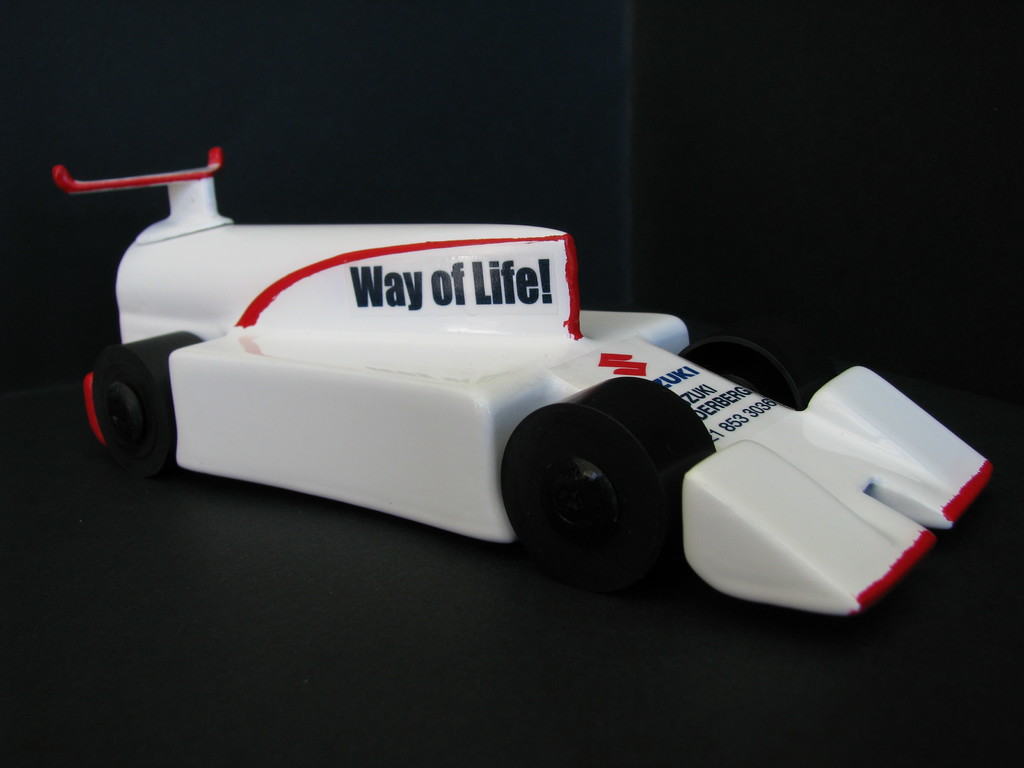
F1 in Schools: Model F1 Car
Completed a solo F1 in Schools model-car project before formal engineering training, using it to self-teach SolidWorks, CAD iteration, and first-principles aerodynamic tradeoffs. The design centered on a whale-tail-inspired rear aerofoil for stability while prioritizing low-drag airflow over downforce-heavy alternatives. The final car combined a CNC-machined balsa body, printed rear wing, and lightweight low-friction wheels, making the project an early practical exercise in design constraints, manufacturing, testing, and engineering judgement.
- Mechanical Engineering
- DIY
MEng Copper Infiltration Study
Completed the Cum Laude MEng project "A study of copper infiltration for conventional ferrous powder metallurgy" at Stellenbosch University. The research commissioned and refurbished a pusher furnace, calibrated process-gas controls, studied delubrication behaviour, and compared furnace operating strategies for copper sinter-infiltration of ferrous powder-metallurgy samples. It combined furnace modification, thermal analysis, controlled atmosphere experiments, sectioning, polishing, SEM/EDS microscopy, defect diagnosis, and process-guideline development to explain black residue, copper pooling, copper balling, and infiltration reliability.
- Mechanical Engineering
- Materials
- Hardware
- Project Management
BEng FAST Apparatus Refinement
Built and validated the final-year BEng project "Refinement of a FAST (Field Assisted Sintering Technique) Apparatus" at Stellenbosch University. The work assessed an existing low-power sintering rig, redesigned the force actuation system, repaired sealing and electrical paths, commissioned new graphite punches, and used FEM plus COMSOL multiphysics modelling to understand stress, resistance, and temperature limits. The apparatus successfully sintered a cobalt sample, supported microscopy and density analysis, and showed that FAST research could be performed with a smaller, lower-cost power supply than commercial systems.
- Mechanical Engineering
- Materials
- Hardware
- Project Management
